Logo Global Warning Networks

⚑ Space Weather Monitor

Real-time geomagnetic storm tracking and aurora forecasts
Monitoring solar activity, geomagnetic storms, and their effects on Earth

Real-Time Auroral Oval Activity

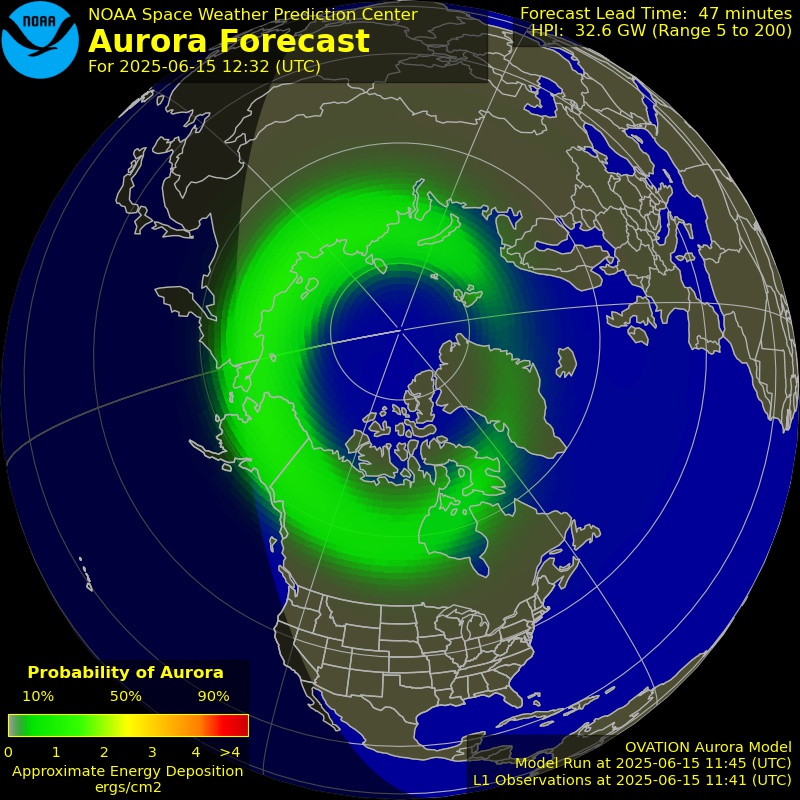
🌌 Northern Hemisphere Aurora

North Pole Auroral Oval

NOAA OVATION Model - Northern Auroral Oval

View from above North Pole β€’ Updated every 5 minutes

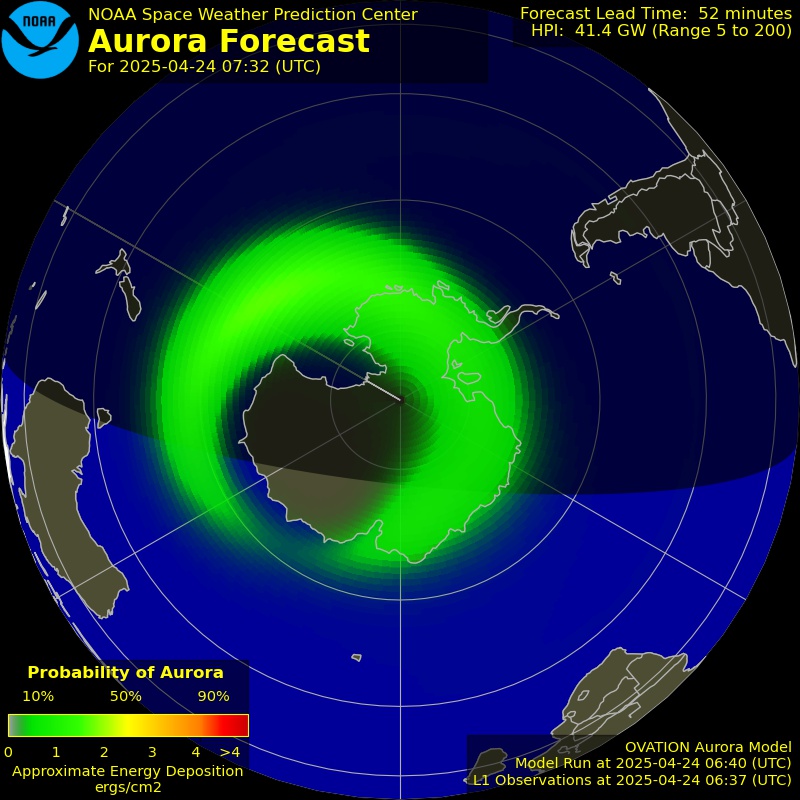
🌌 Southern Hemisphere Aurora

South Pole Auroral Oval

NOAA OVATION Model - Southern Auroral Oval

View from above South Pole β€’ Updated every 5 minutes

Current Geomagnetic Conditions

Current Kp Index

1.7
Kp Index
🟒 G0 - Quiet

Geomagnetic Storm Level

72-Hour Peak Forecast

Expected Peak
4.7
🟒 G0 - Quiet
18-10-2025 03:00 UTC
🟑 Active Storm (Kp 4-5): 28.6%

Storm Scale

🟒
G0 - Quiet (Kp 0-4)
Normal conditions
🟑
G1 - Minor (Kp 5)
Weak power grid fluctuations
🟠
G2 - Moderate (Kp 6)
High-latitude power systems affected
πŸ”΄
G3 - Strong (Kp 7)
Voltage corrections may be required
⚫
G4-G5 - Severe/Extreme (Kp 8-9)
Widespread power system issues

72-Hour Kp Index Forecast

Kp Index Timeline

Forecast Uncertainty Range

Multiple Model Ensemble Forecast

Potential Impacts by Storm Level

⚑

Power Systems

  • 🟒 G0-G1: No impact
  • 🟑 G2: High-latitude power systems may experience voltage alarms
  • 🟠 G3: Voltage corrections may be required
  • πŸ”΄ G4-G5: Possible widespread voltage control problems and protective system issues
πŸ›°οΈ

Spacecraft Operations

  • 🟒 G0-G1: Minor impact on satellites
  • 🟑 G2: Corrective actions may be required by ground control
  • 🟠 G3: Surface charging possible on satellite components
  • πŸ”΄ G4-G5: Increased drag on low-orbit satellites, orientation problems
πŸ“‘

GPS & Navigation

  • 🟒 G0-G1: Minimal GPS degradation
  • 🟑 G2: High-latitude GPS may experience occasional issues
  • 🟠 G3: Intermittent GPS navigation problems
  • πŸ”΄ G4-G5: GPS degraded for hours, inaccurate positioning
πŸ“»

Radio & Communications

  • 🟒 G0-G1: HF radio propagation fades at high latitudes
  • 🟑 G2: HF radio propagation can fade at higher latitudes
  • 🟠 G3: HF radio intermittent disruption
  • πŸ”΄ G4-G5: HF radio propagation sporadic or impossible
🌌

Aurora Visibility

  • 🟒 G0-G1: Aurora visible at high latitudes (Canada, Alaska, Scandinavia)
  • 🟑 G2: Aurora visible as low as New York to Wisconsin
  • 🟠 G3: Aurora may be seen as far south as Pennsylvania to Iowa
  • πŸ”΄ G4-G5: Aurora could be visible as far south as Alabama to California
✈️

Aviation

  • 🟒 G0-G1: No impact on aviation
  • 🟑 G2: Increased radiation exposure for polar flights
  • 🟠 G3: Polar flights may need rerouting
  • πŸ”΄ G4-G5: Airlines avoid polar routes, increased radiation levels

About This Forecast

What is the Kp Index?
The Kp index is a global geomagnetic activity index based on 3-hour measurements from ground-based magnetometers worldwide. It ranges from 0 (quiet) to 9 (extremely disturbed), indicating the severity of magnetic field disturbances caused by solar activity.

Forecast Models:
This forecast uses ensemble predictions from multiple space weather models, including data from NOAA's Space Weather Prediction Center. The forecast shows the median (most likely), minimum, maximum, and probability ranges for the next 72 hours.

Understanding Uncertainty:
Space weather forecasting is inherently uncertain due to the complex nature of solar-terrestrial interactions. The probability bands (0.25 and 0.75 quantiles) show the range where we expect the actual Kp index to fall with 50% confidence.

Data Sources:
Kp index forecasts from NOAA Space Weather Prediction Center β€’ Real-time solar wind monitoring β€’ Coronal mass ejection (CME) analysis β€’ Historical geomagnetic storm patterns