 Global Warning Networks
Global Warning Networks
Global Warning Networks
Real-time coronagraph imagery and solar wind predictions
The Large Angle and Spectrometric Coronagraph (LASCO) onboard the SOHO spacecraft provides continuous observations of the solar corona. These images are crucial for detecting Coronal Mass Ejections (CMEs) that can impact Earth's magnetic field.
Inner Corona (2-6 solar radii)
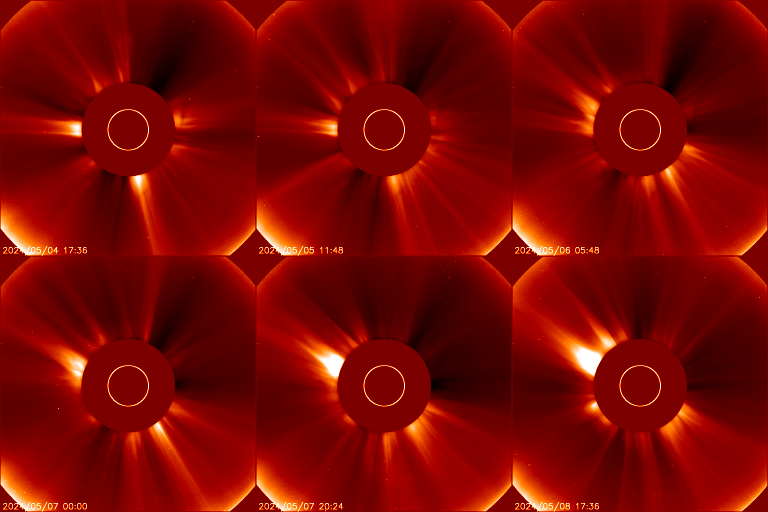
• Field of View: 2 to 6 solar radii
• Best for: Detecting fast CMEs leaving the Sun
• Update Frequency: Every 12-15 minutes
Outer Corona (4-30 solar radii)
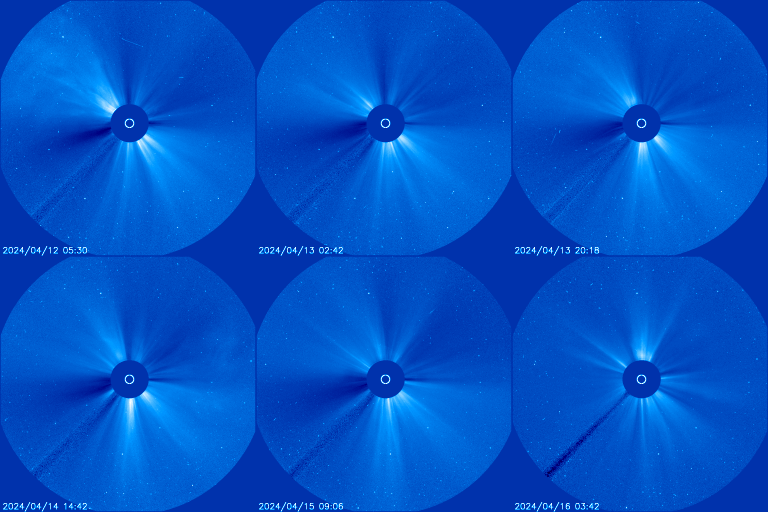
• Field of View: 4 to 30 solar radii
• Best for: Tracking CME propagation toward Earth
• Update Frequency: Every 20-30 minutes
Images auto-refresh every 5 minutes
The WSA-ENLIL model predicts solar wind conditions throughout the heliosphere by simulating the propagation of Coronal Mass Ejections (CMEs) from the Sun to Earth. This model is essential for forecasting geomagnetic storm impacts.
Real-time 3D heliosphere simulation
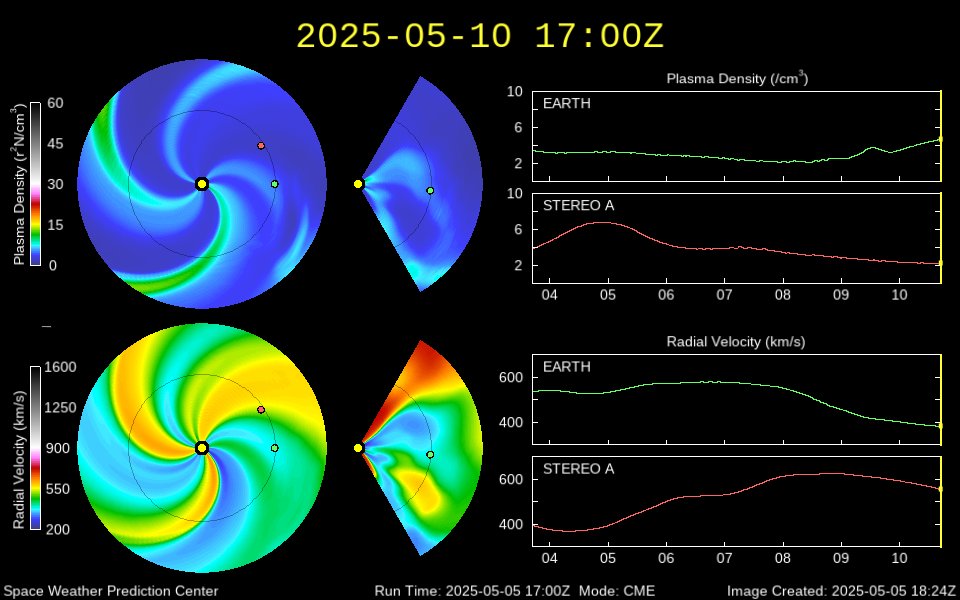
Density (Left Panels)
Speed (Right Panels)
⚡ How to read: This model shows a 3-4 day forecast. The small blue dot is Earth. Watch for red/orange regions approaching Earth's position - these indicate potential geomagnetic storm impacts.
Opens interactive model in new window
Coronal Mass Ejections are massive bursts of solar wind and magnetic fields rising above the solar corona or being released into space. A single CME can contain billions of tons of matter accelerated to speeds of several million miles per hour.
When a CME reaches Earth (typically 15-18 hours for fast CMEs, 2-3 days for slower ones), it can compress Earth's magnetosphere, causing geomagnetic storms that may disrupt satellites, power grids, and radio communications while creating beautiful auroras.
SOHO's LASCO coronagraphs detect CMEs as they leave the Sun, while the WSA-ENLIL model forecasts their trajectory and arrival time at Earth. This early warning system gives us 1-3 days to prepare for potential space weather impacts.
Aurora visibility forecast
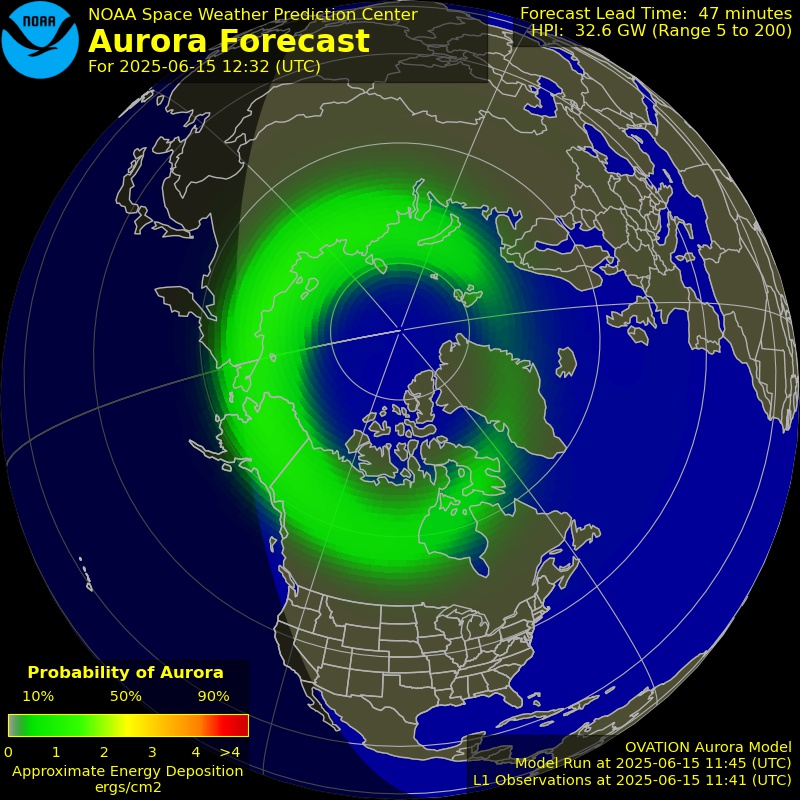
Color Scale:
Aurora visibility forecast
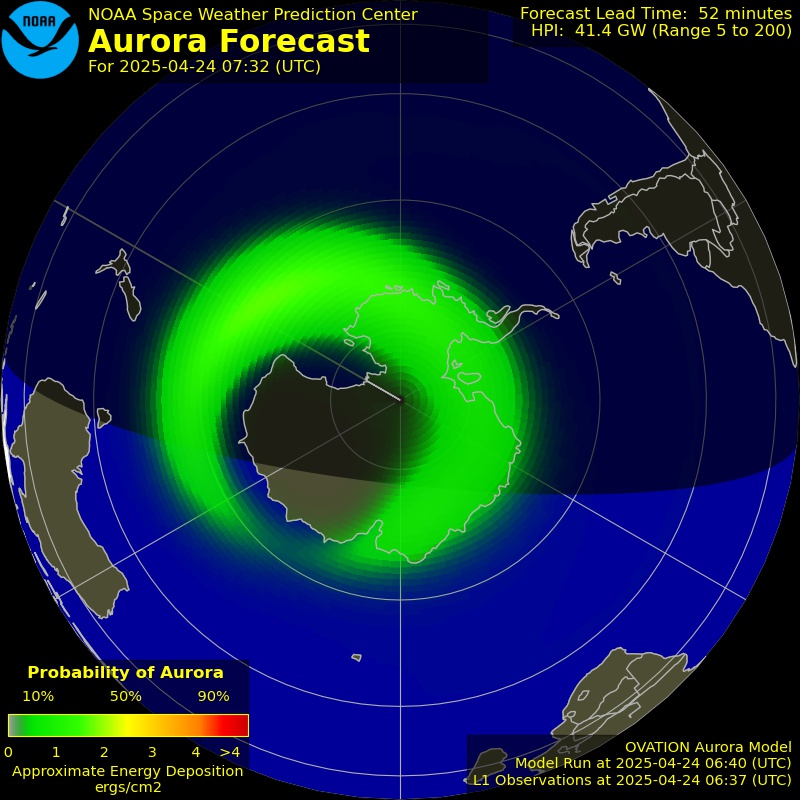
Color Scale:
Images & Kp auto-refresh every 30 minutes
View Full Aurora Forecast on NOAAThe Solar and Heliospheric Observatory (SOHO) is a joint ESA/NASA mission launched in 1995. The LASCO instrument consists of three coronagraphs (C1, C2, C3) that image the solar corona from 1.1 to 30 solar radii. Data updates continuously with C2 images approximately every 12-15 minutes and C3 images every 20-30 minutes.
The Wang-Sheeley-Arge (WSA) and ENLIL models work together to predict solar wind conditions throughout the inner heliosphere. WSA provides coronal boundary conditions based on observed solar magnetic fields, while ENLIL simulates the 3D evolution of solar wind plasma and CME propagation. Models are updated every 6-12 hours or when significant CMEs are detected.
The Planetary K-index (Kp) is a 3-hourly quasi-logarithmic local index of geomagnetic activity calculated from measurements of the horizontal component of the magnetic field. NOAA provides real-time 1-minute estimates.